Local detail
How Local Conditions Play In
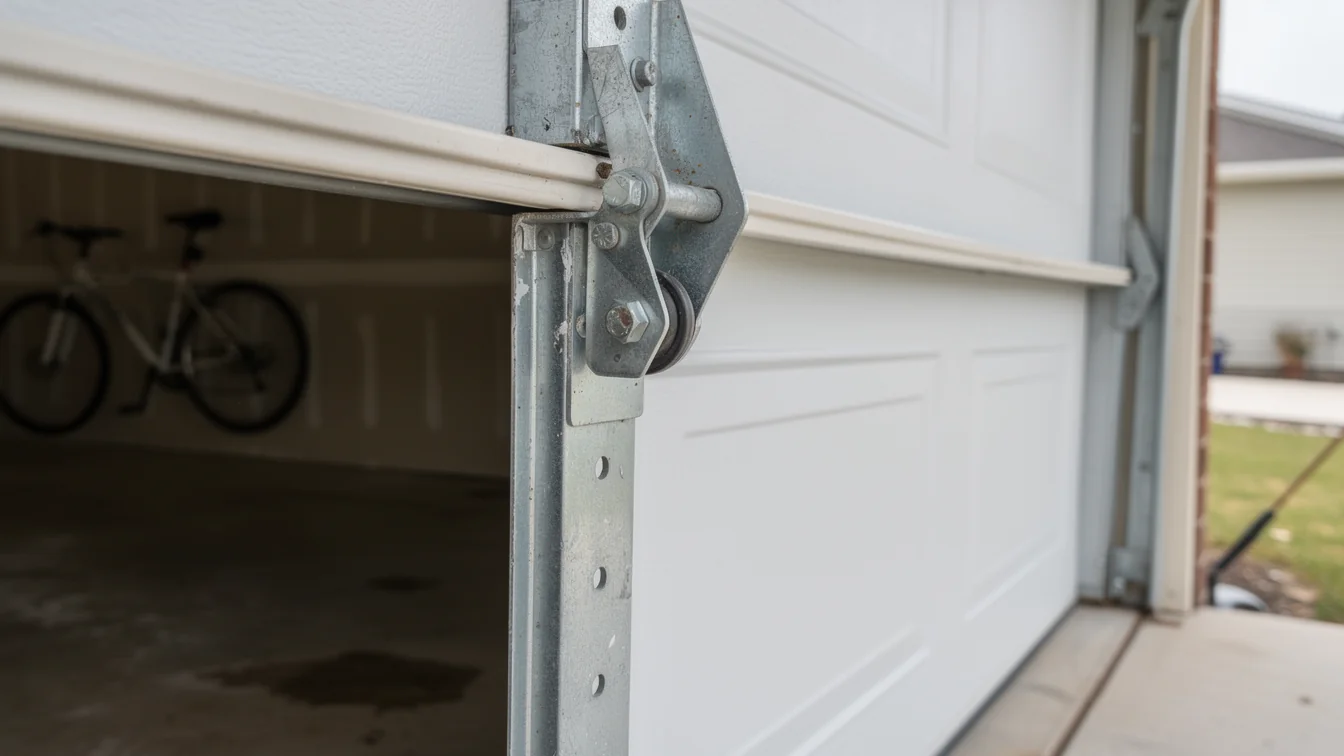
Royal Oak's housing stock mostly went up between 1938 and 1990, with the typical build year sitting around 1957. That matters for noise because a door installed on a house from that era is often still running its second or third opener bolted onto original track brackets, or a torsion spring swapped out once sometime in the last few decades without anyone touching the rest of the hardware. A lot of the grinding, popping, and banging we get called about isn't the door failing all at once - it's sixty-plus-year-old steel finally announcing that the lubrication dried up years ago.
The cold is the other half of it. This area sits in a severe cold climate band, and that means real freeze-thaw cycling on anything metal mounted in an unheated garage. Steel contracts in deep cold, which tightens tolerances on rollers and hinges that were already loose from age. A door that rolled quiet in August can start screeching in January for no reason other than the temperature dropped forty degrees. Across the roughly 45 older neighborhoods that make up this part of the service area, that combination - old hardware plus hard winters - is the single biggest reason doors get noisy here specifically, not generic wear you'd hear anywhere.
The area
Doing Nothing For Now
Not every noise means call today. A single dry squeak on a roller, especially right after a cold snap, is often just friction - lubricant gets stiff below freezing and loosens back up once it warms. If the door still opens smoothly, closes flush, and the sound doesn't change week to week, you can usually wait and see.
What you shouldn't ignore is a noise that's getting louder or changing character - a squeak that turns into a thud, or a rattle that starts happening mid-cycle instead of at the start. On houses from the 1938-1990 range, that shift often means a spring or cable is losing tension, and those don't fail gently in cold weather. They fail suddenly, usually on the coldest morning of the year, which is also the worst time to be stuck with the car trapped inside.
Here's the honest limit: we can tell you a lot over the phone from a description, but we can't diagnose a spring or cable from sound alone with full certainty. Some noises genuinely need eyes on the opener and the track before anyone can say whether it's a ten-minute fix or a bigger job.
What we find
What You Pay
We're not going to list prices here that don't hold up house to house - a torsion spring job on a single door is a different job than a cable replacement on a double door with a stretched chain opener, and the honest number depends on what's actually worn. What we can tell you is what drives the cost in this area: age of the hardware, whether it's a single spring system or two, and whether the opener itself needs attention along with the door.
Given that median household income across this service area runs around $70,185 and most of the housing stock predates 1990, a lot of the jobs we see are repair-first rather than full replacement - fixing the specific worn part rather than pulling the whole door. That tends to keep cost down compared to a full teardown, but it only works if the rest of the hardware is still sound. If a door has been limping along on multiple worn parts at once, patching one piece can just mean the next one fails a few months later.
How we work
The Situation
We work out of Royal Oak and cover the surrounding area - Berkley and Huntington Woods are about two miles out, Pleasant Ridge, Madison Heights, and Oak Park sit around three, and Ferndale, Lathrup Village, Birmingham, Hazel Park, and Beverly Hills are roughly four. Farther out we reach Bingham Farms, Center Line, and Bloomfield Hills near six to seven miles, and go as far as Rochester, Auburn Hills, and the Grosse Pointes on the longer end of the service area.
Across that territory you've got close to 288,119 households and 158,601 owner-occupied houses, a large share of them built in that same 1938-1990 window with a median right around 1957. That's a lot of original or early-replacement hardware sitting in unheated garages through the same hard winters. The noise complaints we hear in Berkley sound a lot like the ones in Ferndale or Hazel Park, for the same structural reasons - same era of construction, same climate doing the same thing to steel every winter.
Talk to a local pro
Garage door trouble in Royal Oak?
Same-day service with honest, upfront quotes.